Unlocking the Power of RICE: A Newcomer’s Handbook to Product Prioritization
Introduction
Imagine you have a superpower that helps you decide which features or projects to tackle first. That’s the RICE Framework — a friendly tool for product managers. It has four parts: Reach, Impact, Confidence, and Effort. These parts work together to guide you in choosing what will have the most impact with the least effort. In this guide, we’ll break down each piece of the RICE Framework, making it easy for beginners to understand how it can turn decision-making into a superpower in the world of product management.
Components of RICE Framework
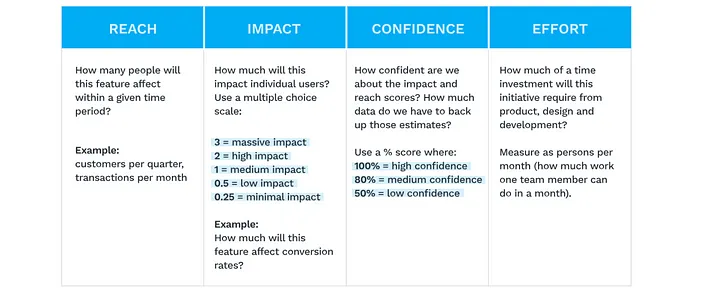
Reach: How many users will use this feature? If you think about 7 out of 10 users will love personalized avatars, then the reach is 70%.
Impact: How much will users enjoy this feature? If you believe it will make users super happy and engaged, the impact is high.
Confidence: How sure are you about these estimates? If you’ve done surveys and got positive feedback, your confidence is high.
Effort: How much time and work is needed? If it’s a bit tricky but doable, the effort might be moderate.
What is RICE Score?
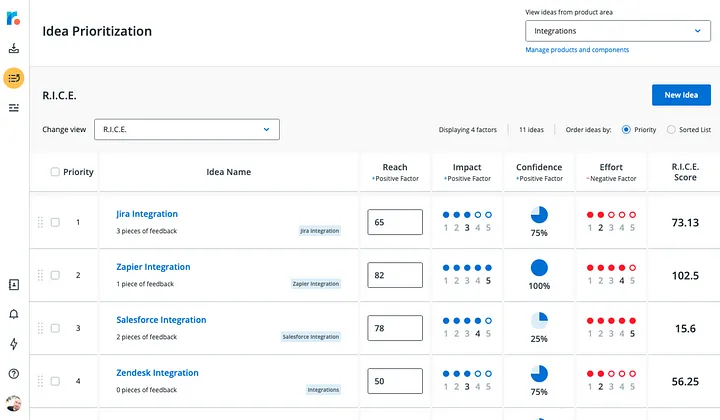
A RICE score is a numerical value obtained using the RICE Framework, a prioritization method in product management. It helps product managers decide which features or projects to focus on first. The RICE score is calculated by multiplying the Reach, Impact, and Confidence, and then dividing by Effort:
RICE score Formula = (Reach x Impact x Confidence / Effort) A higher RICE score indicates a feature or project with a potentially greater impact relative to the effort required, making it a priority for implementation.
How we can calculate reach?
Example: Introducing a New Chat Feature in a Social Media App
1.Number of Users: Let’s say our social media app has a total of 1 million users.
2.Percent of Users Affected: We estimate that the new chat feature will directly impact users who engage in private messaging. Considering that 70% of our users use private messaging regularly, this becomes our percentage.
So, in this example, the Reach for the new chat feature is estimated to be 700,000 users. This helps us understand the potential impact on a significant portion of our user base, guiding us in prioritizing features that can reach a large audience.
How we can calculate impact?
When we talk about the impact of a feature, we want to know how much it will positively affect users and the business. Let’s use an example of adding a new feature to a photo editing app:
1.Think of the Good Things: What good things will happen because of this feature? For the photo editing app, it might make users really happy, encourage them to use the app more often, and bring in some additional income.
2.Percent of Users Affected: We estimate that the new chat feature will directly impact users who engage in private messaging. Considering that 70% of our users use private messaging regularly, this becomes our percentage.
So, in this example, the Reach for the new chat feature is estimated to be 700,000 users. This helps us understand the potential impact on a significant portion of our user base, guiding us in prioritizing features that can reach a large audience.
How we can calculate impact?
When we talk about the impact of a feature, we want to know how much it will positively affect users and the business. Let’s use an example of adding a new feature to a photo editing app:
1.Think of the Good Things: What good things will happen because of this feature? For the photo editing app, it might make users really happy, encourage them to use the app more often, and bring in some additional income.
2.Rate the Importance: Give a score to each of these good things. For instance, you might say making users really happy is very important (5), encouraging more app use is somewhat important (3), and bringing in extra income is less important (2).
Formula : impact=(5+3+2) Total impact points: 10
How we can calculate Confidence?
Confidence is about how sure you are in your estimates for Reach, Impact, and Effort. Think of it like how confident you are in predicting what will happen.
Now, let’s use our photo editing app example:
Estimate the Certainty: Consider how sure you are about the numbers you’ve given for Reach, Impact, and Effort. If you feel very confident in your estimates, give it a high score. If there’s more uncertainty, give it a lower score.
Reach: You’re pretty sure many users will use this feature (High Confidence — 4).
Impact: You’re confident it will make users happy, but predicting exact numbers is a bit tricky (Medium Confidence — 3).
Effort: You’re confident it won’t take too much effort to implement (High Confidence — 4).
Confidence formula:Confidence = (4+3+4)
It means you got 11 points and it show good output so you can implement this feature because you got 11/12.
How we can calculate Effort?
Assign Points: Estimate the effort involved on a relative scale. For instance:
Low effort might be assigned 1 point. Medium effort could be 3 points. High effort might be 5 points.
Consider Resources and Time: Evaluate factors like the complexity of development, design work, testing, and any other relevant aspects that contribute to effort.
Example: Let’s say you’re considering adding a new search feature to an e-commerce platform:
Condition 1: If it’s a straightforward search with minimal design changes, you might assign a low effort score of 1 point.
Condition 2:If it involves more advanced functionalities like filters, sorting, and a complex design overhaul, you might give it a medium effort score of 3 points.
Condition 3:If the search feature requires intricate algorithms, integration with other systems, and extensive testing, it could be deemed high effort, earning 5 points.
Why do product managers like to use a RICE score for prioritization?
Product managers like using a RICE score for prioritization because it helps them figure out which ideas or features to work on first. It’s like a roadmap that considers how many people will be affected (Reach), how much impact it will have (Impact), how confident they are about the estimates (Confidence), and how much effort it will take to get it done (Effort). It’s a smart way to make decisions, save time, and focus on what will make the biggest difference for the business and users.
Steps to use RICE Framework in Your Project
Imagine you’re a chef planning your menu. Each dish has different ingredients, preparation times, and popularity among customers. Similarly, the RICE framework is like a recipe for prioritizing features in product management.
Step -1: Ingredients (Ideas):
Think of your feature ideas as unique dishes. For instance, a quick checkout process (Idea A) and personalized product recommendations (Idea B).
Step -2 : Preparation (Reach, Impact, Confidence, Effort): Each dish (idea) has its characteristics. How many people will love it (Reach)? How much will it impress (Impact)? How certain are you about its success (Confidence)? And, how much effort goes into making it (Effort)? Cooking (Calculating RICE Score).Now, mix these ingredients by calculating the RICE score. It’s like finding out which dish is the star based on its popularity, taste, and ease of preparation.
Step-3 : Serving (Prioritization): Serve the dish with the highest RICE score first. In our example, if the quick checkout process (Idea A) gets a higher score, serve it to your customers (users).
Step -4 : Tasting (User Feedback): Just like tasting your dish, gather feedback from users. Adjust your recipes (features) based on what they love, and keep refining your menu (product roadmap).
Conclusion:
The RICE Framework is a superhero for product managers, simplifying prioritization by assessing Reach, Impact, Confidence, and Effort. It transforms complexity into clarity, guiding decisions towards impactful features aligned with business goals. Just as a chef crafts a menu, product managers curate roadmaps that captivate users. RICE is more than a score; it’s a compass, ensuring wise prioritization for lasting user satisfaction and product success. Cheers to RICE — the recipe for triumph in product management!