Role
Product Designer, System Redesign


Where intake and matter creation were the same overloaded form — until they became two connected systems, one AI-assisted and one fully manual.
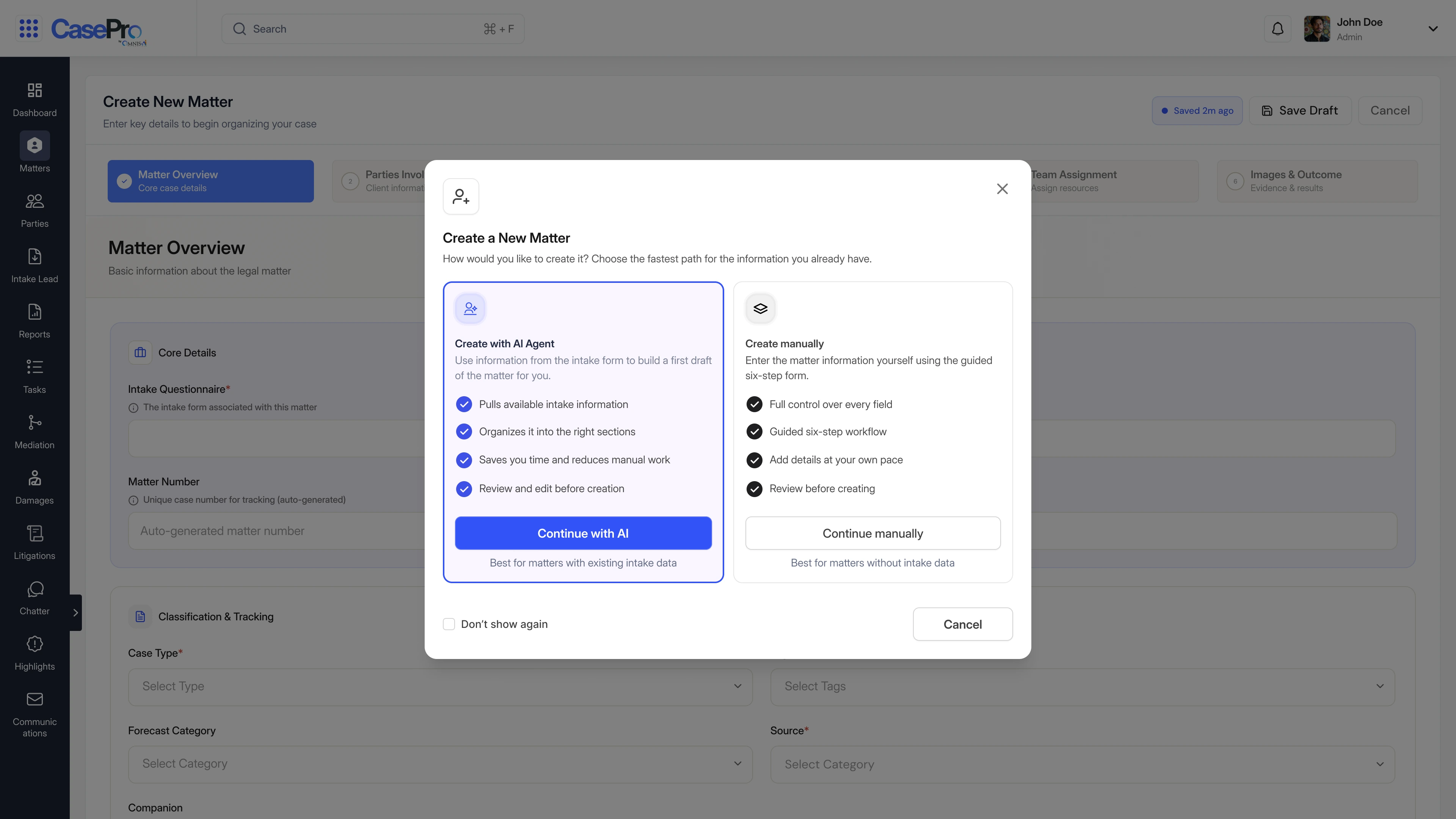
CasePro is the practice-management layer law firms use to run a case from the first client call to close — matters, parties, incident facts, documents, deadlines, and legal-team staffing, all in one system.
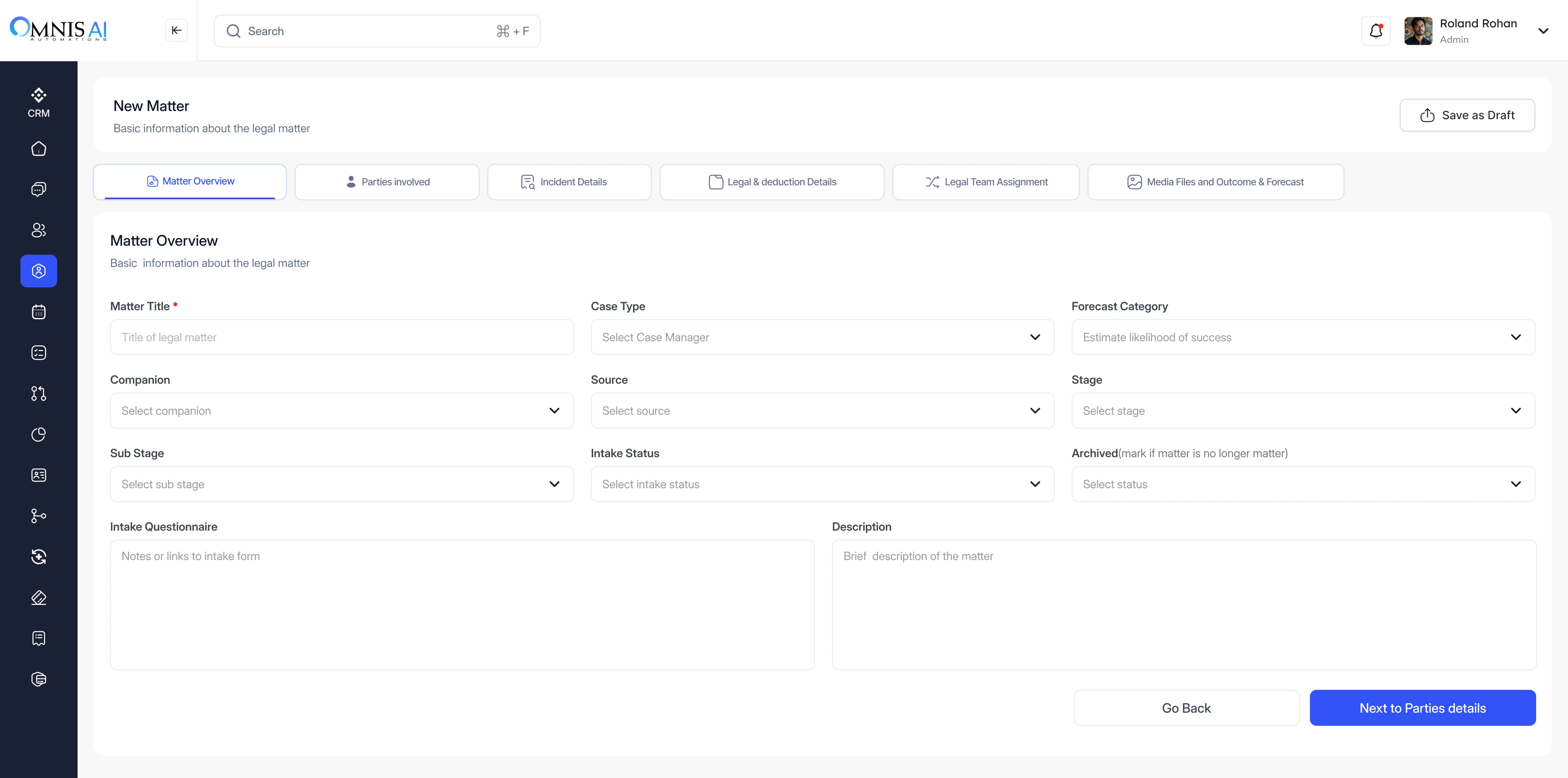
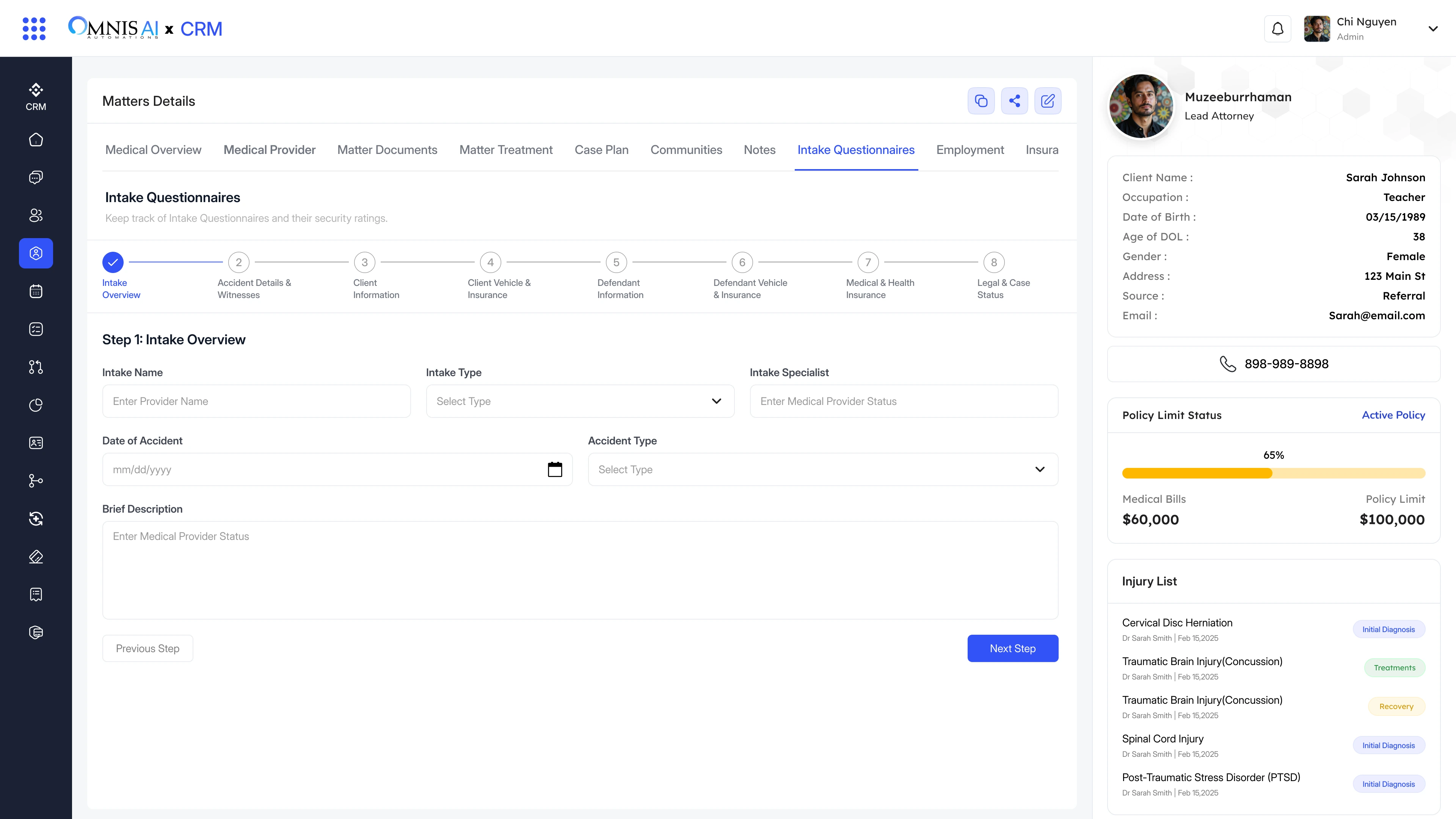
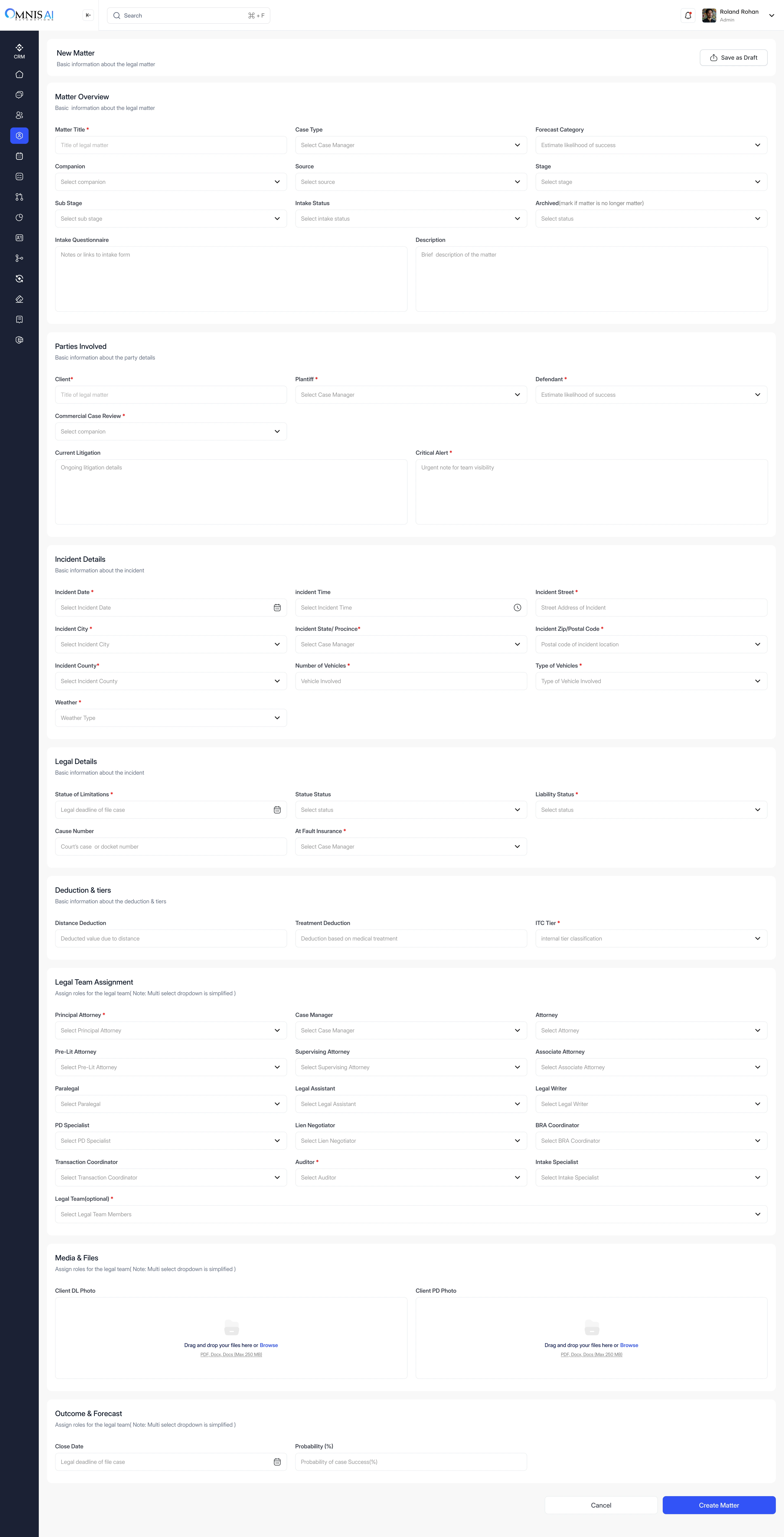
Designed around two different jobs, not one form. Before this redesign, opening a new case meant filling out a single "New Matter" wizard that mixed a client's raw intake story with case metadata, incident facts, legal-team assignment, and outcome tracking — six tabs deep, with the client's intake reduced to a free-text box labeled Notes or links to intake form.
Rebuilt as two linked systems, not one mega-form. Intake became its own structured, firm-customizable questionnaire. Matter creation became a deliberate second step that could pull from that intake automatically, or start from a blank slate when a firm chose to build the record by hand.
The legacy matter form, still visible below, treated intake as an afterthought and treated every case — a two-car accident, a medical malpractice claim, a commercial dispute — as one identical, generic slog.
I sat with the people who processed new matters every day — intake specialists, paralegals building files after client calls, and the ops lead who owned the CRM configuration. Rather than starting from a blank redesign, I traced the existing form field by field: which ones were duplicated between "intake" and "matter," which ones nobody ever filled in, and which decisions — statute-of-limitations deadlines, legal-team staffing — had no system support at all and lived entirely in someone's memory.
A redesign is easy to justify with a strong opinion and one bad screenshot. Before proposing anything, I wanted three independent signals to agree with each other, not just my own read of the form.
All three pointed at the same root cause from three different angles: the form wasn't badly laid out. It was structurally answering two different questions — what did the client tell us and what is the legal record — as if they were one question, and everyone touching it had quietly adapted around that instead of naming it.
That trace surfaced the actual bug. It wasn't a layout problem, and more validation rules wouldn't have fixed it.
Once the root cause was clear, the fix wasn't obvious yet — it rarely is. I brought three real options to stakeholders, not one polished recommendation, because the fastest option and the AI-forward option were both genuine temptations that would have shipped a version of the same bug under a nicer coat of paint.
Rejected — a better-looking version of the same bug. Intake still couldn't be customized per firm, still couldn't be reused, still only existed inside a matter that already had to be created first.
Rejected — assumes every matter starts from a complete intake. Many don't: walk-in clients, a five-minute phone note. Forcing AI-only creation onto those cases meant either blocking the user entirely or letting the model quietly fill gaps in a legal record with no human in the loop.
Chosen — the only option that fixed the data-model root cause and matched how matters actually start: sometimes with a client's full story already captured, sometimes with almost nothing.
Intake became its own object, with its own lifecycle, instead of a field inside a matter. That unlocked something the old model structurally couldn't: a firm can now define its own intake questions — the accident-type list for a state that regulates it differently, the statute-of-limitations triggers specific to a county, the extra fields a personal-injury practice needs that a commercial-litigation practice never will — without an engineer touching the matter schema, and without every firm on the platform being forced onto one generic questionnaire.
To reduce the time it takes a client's story to become usable data, intake capture itself was designed to be AI-assisted at the source: a voice agent that can answer or join a client's call, transcribe it, and populate the structured intake fields directly — instead of a paralegal typing rough notes into a blank box after the fact and hoping nothing was missed. Whether a field lands there from that call, a web form the client filled in, or a paralegal's manual entry, it becomes a candidate the matter can pull from later.
Not every matter starts with a complete intake. Some arrive from a thorough client call with every field captured; others start from a five-minute phone note or a walk-in client with almost nothing on file yet. A single "AI-generate the matter" button that assumes perfect intake data isn't a feature — it's a bet the product would force the user to take on every single case, whether or not the data supported it. So matter creation became a deliberate fork: let the person creating the matter tell the system how much is already known, and route them accordingly.
Instead of hiding the AI-vs-manual decision inside a settings toggle or defaulting silently to one mode, it's the very first screen after "Create New Matter" — presented as two equally legitimate paths, each with its own tradeoffs stated up front rather than discovered halfway through the flow.
The risk with any "let AI build it for you" flow is that it either overpromises silently or leaves the user with no way to tell what came from real data versus a guess. The AI path was built to make that distinction visible at every step, from the moment it starts reading the intake record to the final review screen before a matter is created.
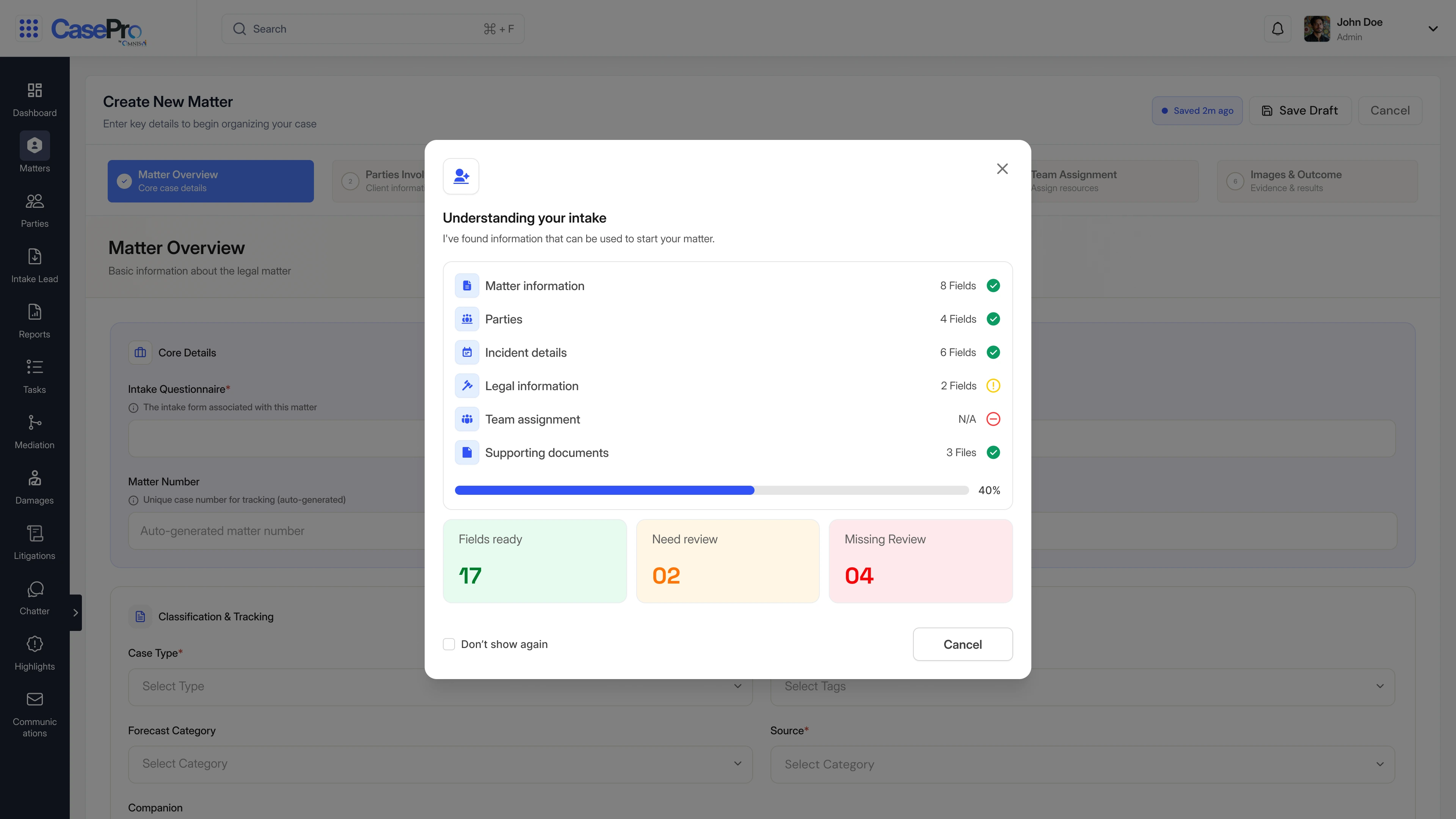
Before drafting anything, the agent scores exactly how usable the linked intake record is — how many fields are ready to use as-is, how many need a human glance, and how many are missing outright. That score is shown to the user, not buried in a log.
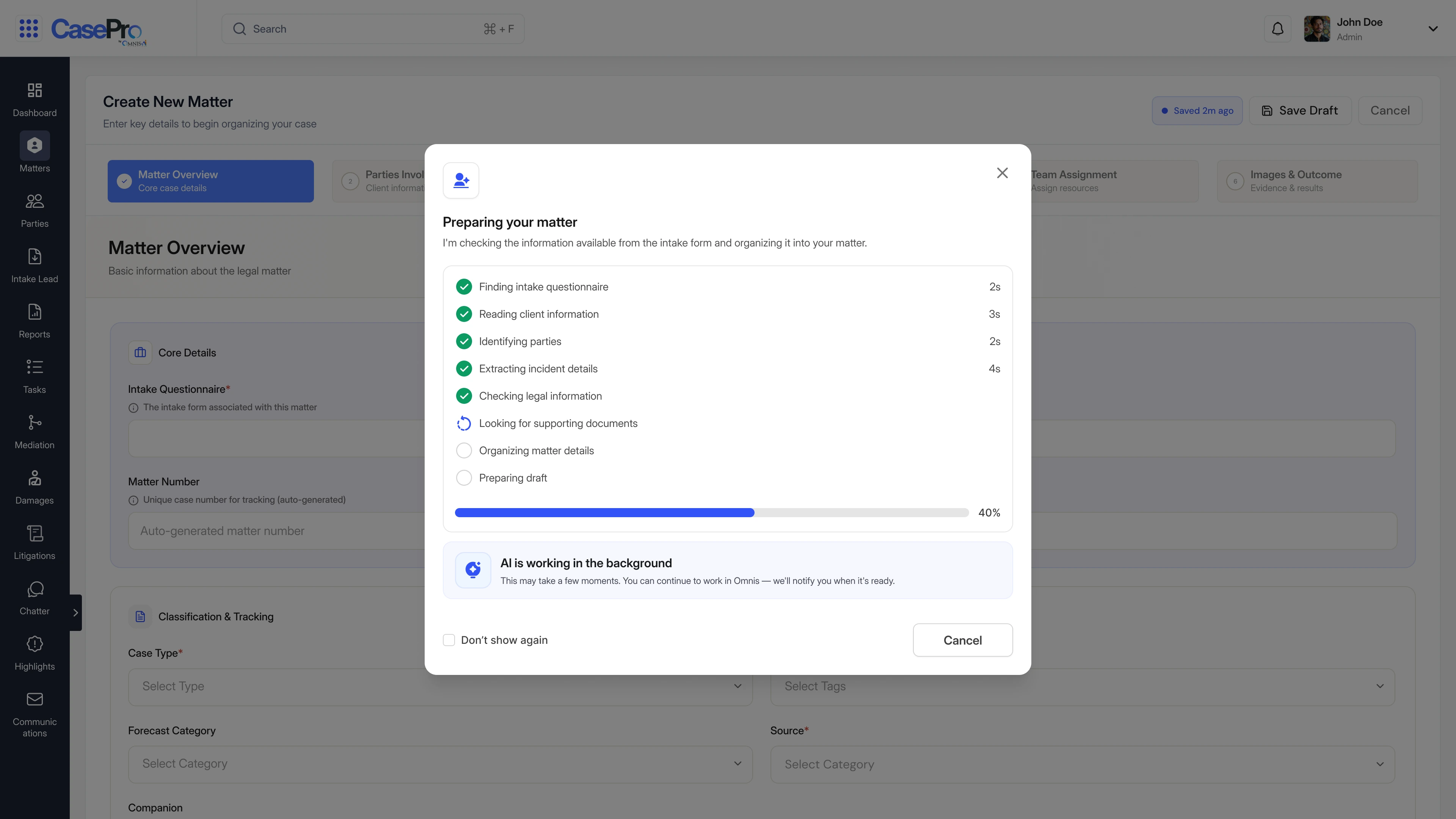
The agent narrates its own work step by step — finding the intake questionnaire, reading client information, identifying parties, extracting incident details, checking legal information — and states plainly that it's running in the background, so the user is never stuck staring at a spinner or forced to babysit the screen.
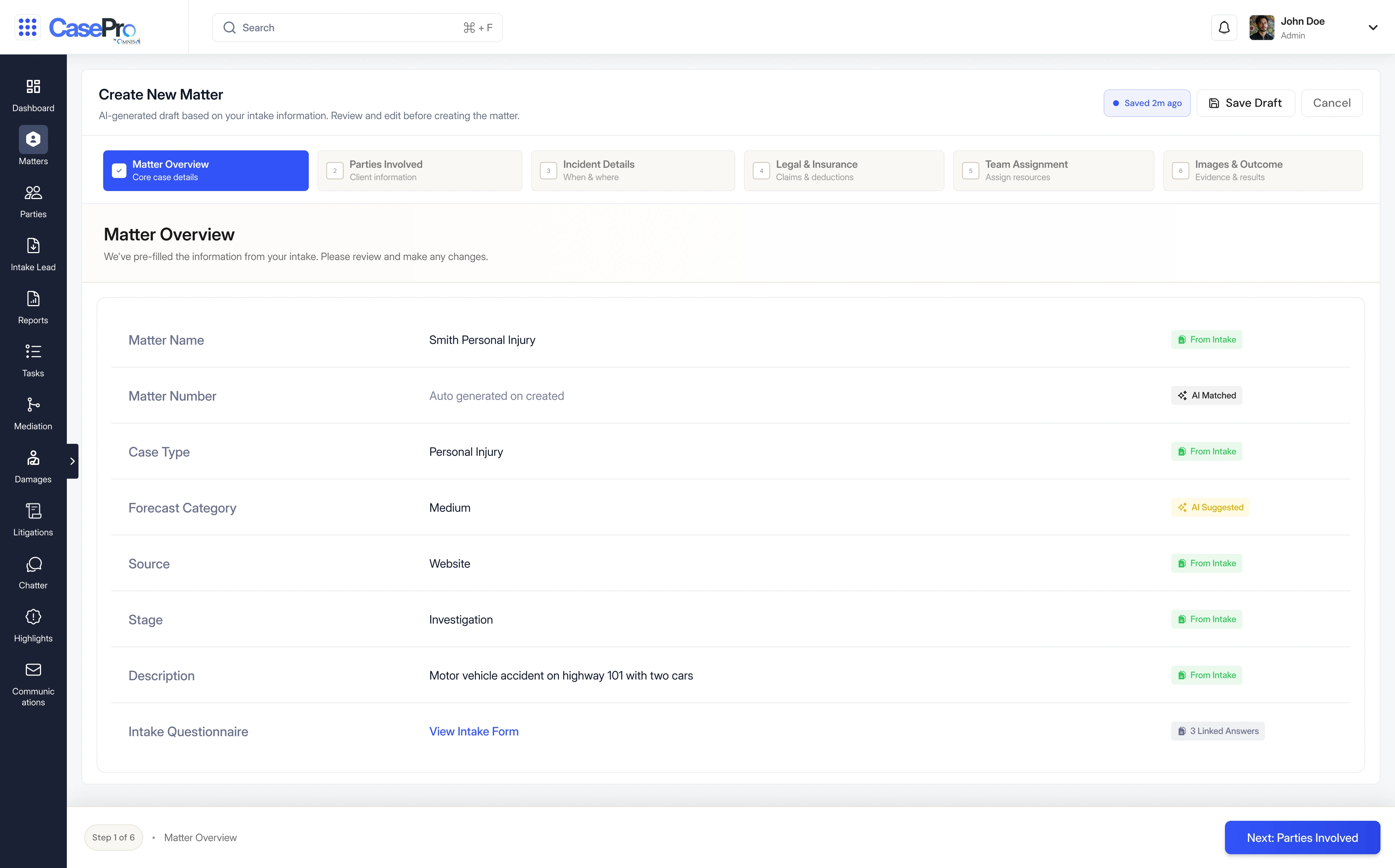
This is the detail that makes the whole path trustworthy: every field in the drafted matter carries a provenance tag — From Intake, AI Matched, or AI Suggested — so a reviewer knows in one glance whether a value is a verified fact, a confident inference, or a guess that deserves a second look before the matter goes live.
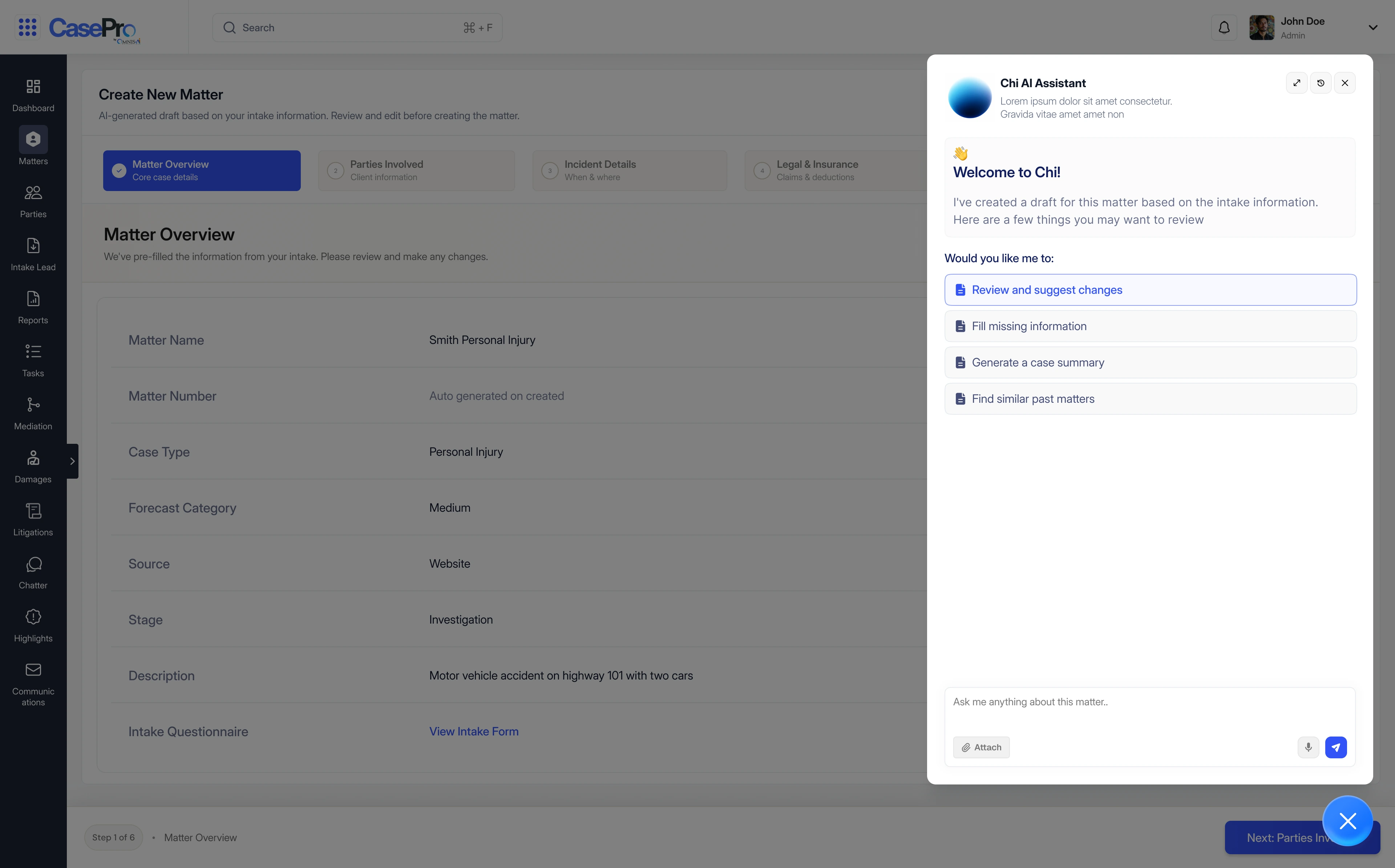
Rather than sending the user back to the intake readiness score to figure out what's missing, an in-context assistant offers direct next actions — review and suggest changes, fill missing information, generate a case summary, or find similar past matters — right where the reviewer is already working.
Regardless of how confident the draft is, the last step of the AI path is identical to the manual path: every section, grouped and labeled, with an explicit Ready to Create Matter confirmation before the record is written. AI assistance ends where the legal record begins.
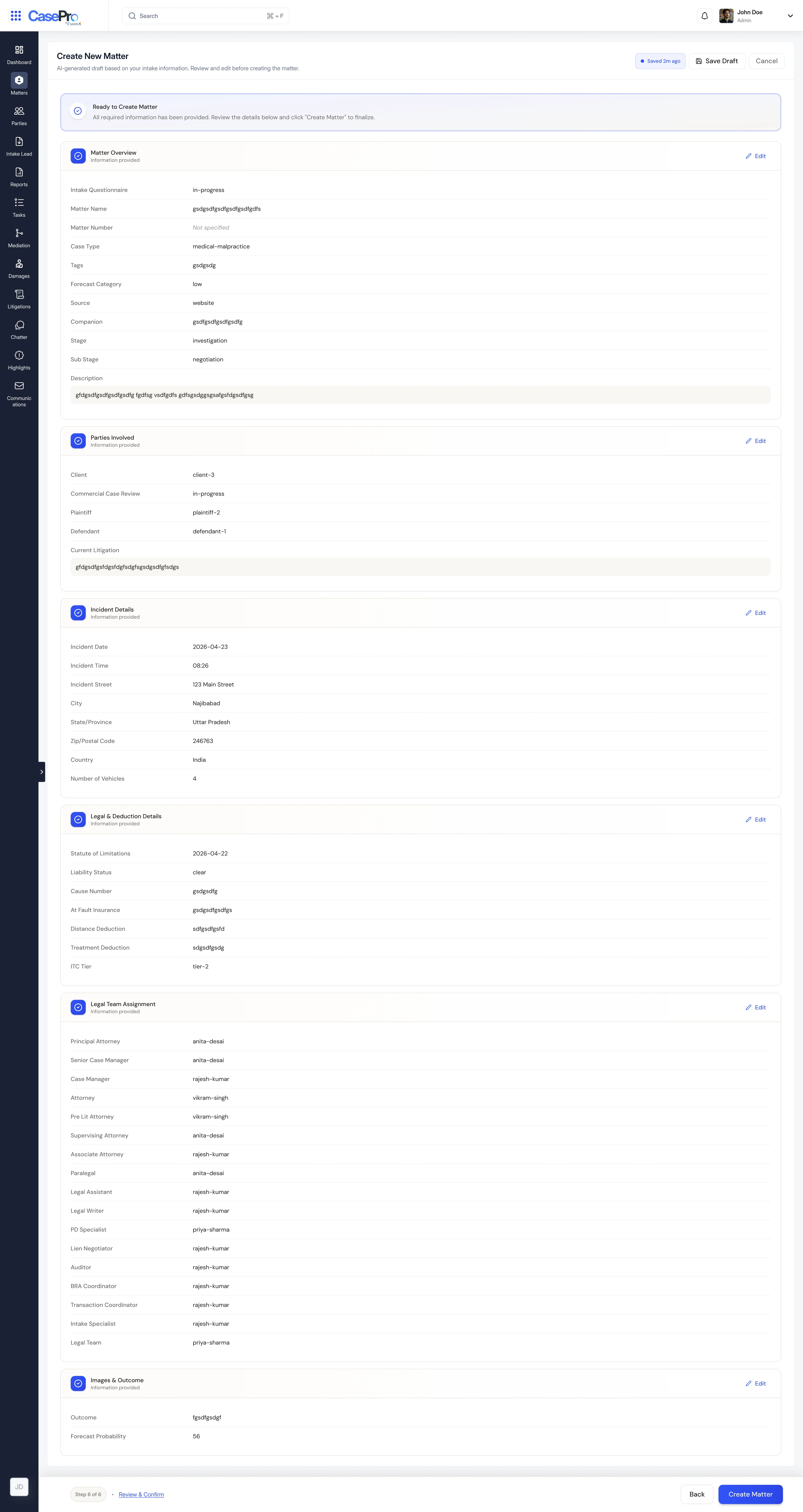
A common failure mode in "AI-assisted" products is treating the non-AI path as a second-class, unmaintained fallback. Here, both paths share the exact same six-step information architecture — Matter Overview, Parties Involved, Incident Details, Legal & Insurance, Team Assignment, Images & Outcome — so a user's mental model never breaks depending on which button they clicked first.
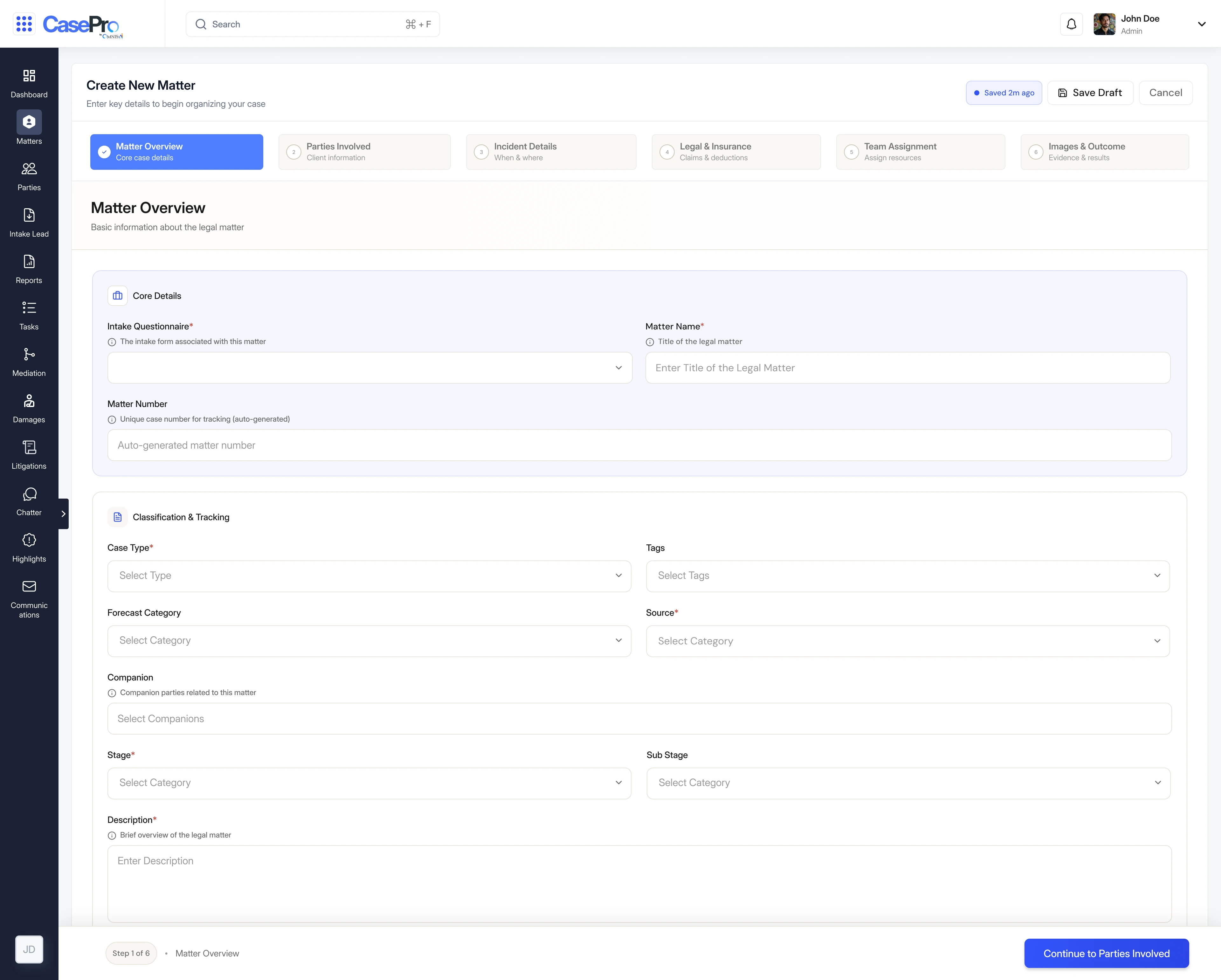
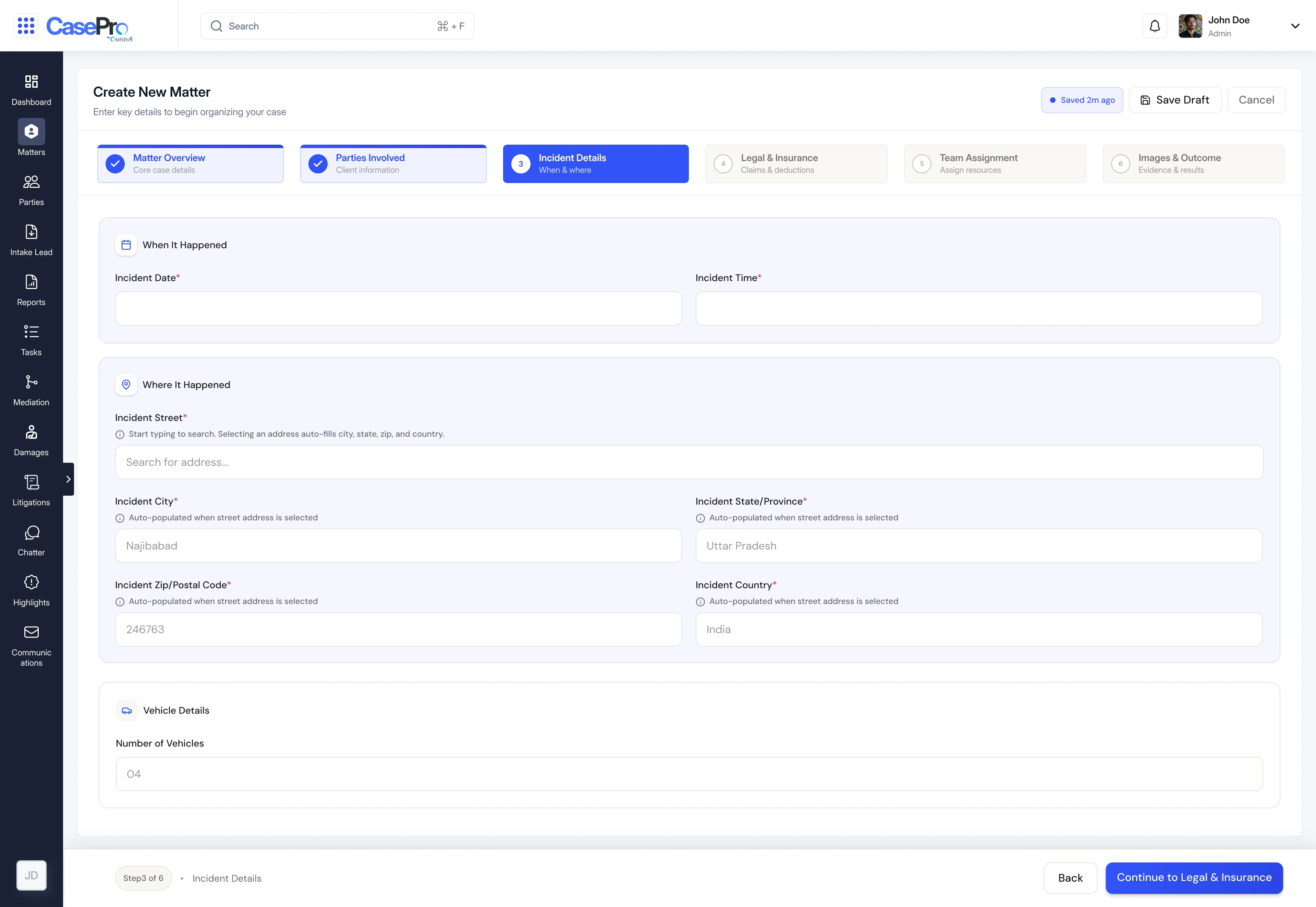
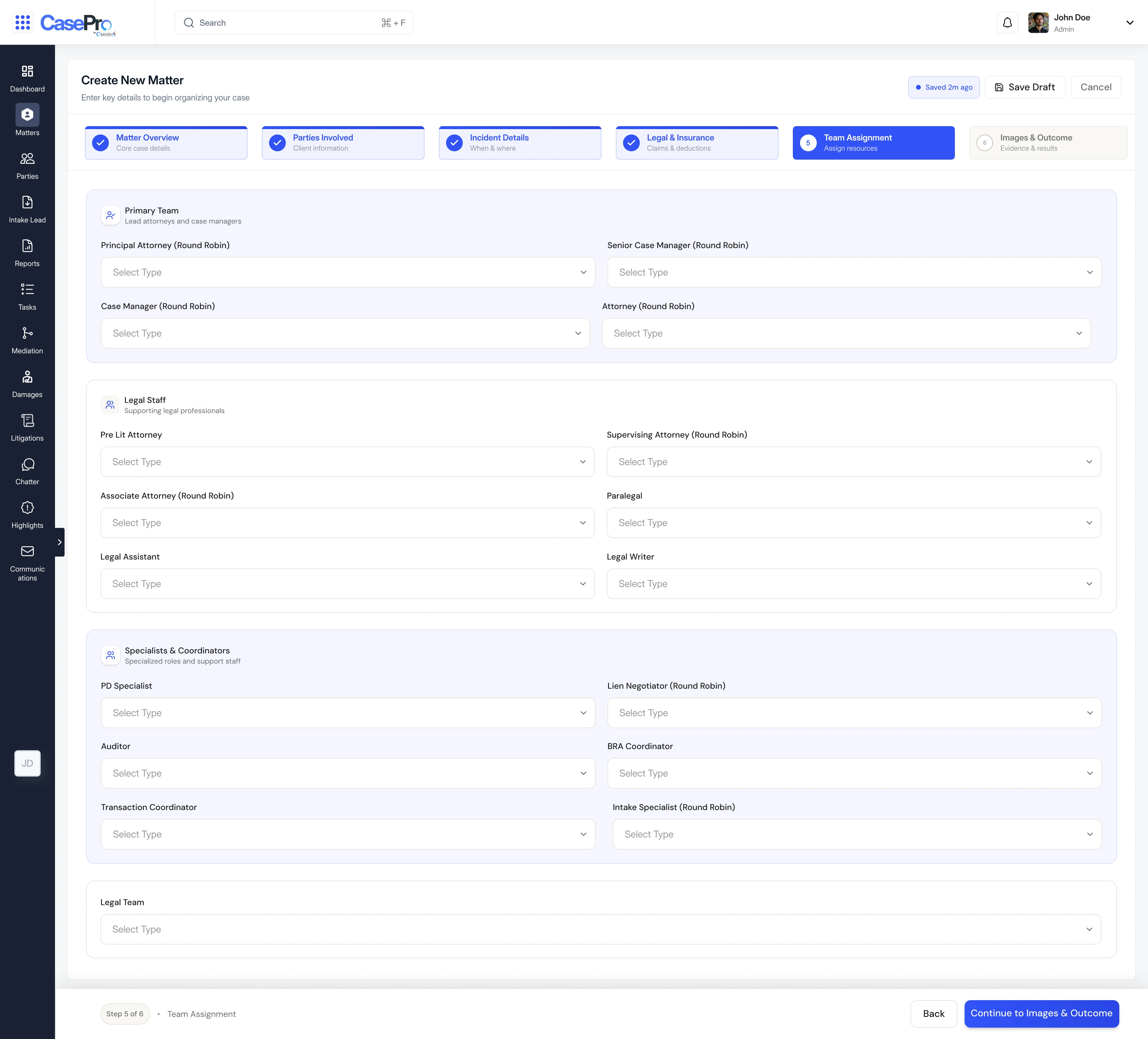
None of these are headline features on their own. Together, they're the difference between a redesign that looks clean in a screenshot and one that a paralegal actually trusts on a real case.
Every AI-touched field is tagged From Intake, AI Matched, or AI Suggested — never presented as one undifferentiated "auto-filled" block.
Intake completeness is scored per category before the AI path even starts drafting, so the user chooses a path with real information, not a guess.
Both paths replace the legacy's undifferentiated field list with labeled sections — Core Details, Classification & Tracking — so a long form still reads as a set of decisions.
Selecting an incident address auto-fills city, state, and zip; the statute-of-limitations deadline auto-calculates from the incident state and date, with a manual override always available.
Team-assignment roles surface the firm's own round-robin logic as a suggestion, so staffing a matter isn't starting from twelve empty dropdowns.
Both paths converge on the identical grouped review screen before "Create Matter" — AI assistance speeds up the draft; it never skips the confirmation.
That's where this case study started — someone doing real, careful work on a client call, then watching almost none of it survive into the matter they had to build next. Here's what changed for each of them, specifically.
What they capture on the client call is no longer a side note someone else re-types later — it's the record the matter itself is built from, structured to their firm's own questions from the start.
No more silently reconciling "what the client said" against "what the matter form wants." Either they confirm an AI-drafted record field by field with visible provenance, or they fill in one clean guided form — never both, never twice.
A matter arrives at the same reviewable, grouped record no matter which button someone clicked to create it — so trust in the system doesn't depend on knowing which path was used. Firms can also reshape their own intake questions without opening an engineering ticket.
The redesign started with the data model — separating intake from matter — before a single new screen was drawn, so the UI changes actually resolved the root cause.
Readiness scores, narrated progress, and field-level provenance tags all exist for the same reason: an AI-assisted legal record has to show its work.
Manual matter creation shares the AI path's information architecture and its smart-field assists, rather than shipping as the unmaintained fallback.
